

Montgomery County Community College’s Alpha Kappa Zeta chapter of Phi Theta Kappa was named a 2025 REACH chapter. Photo by Dave DeBalko
Montgomery County Community College’s Alpha Kappa Zeta chapter of Phi Theta Kappa (PTK), the international honor society for two-year colleges, recently celebrated a milestone achievement, as it’s been named a 2025 REACH chapter by the organization.
PTK’s REACH (Recognizing Excellence in Acceptance and Completion with Honors) Rewards program recognizes and rewards chapters that excel in membership development. To qualify, the Alpha Kappa Zeta chapter needed more than 15 percent of students invited to accept membership into the honor society during a calendar year. In 2025, 222 students accepted, up from 181 in 2024. The chapter will receive special PTK graduation stoles for members to keep and wear during Commencement. Alpha Kappa Zeta chapter has received the REACH award every year since it was introduced in 2016.
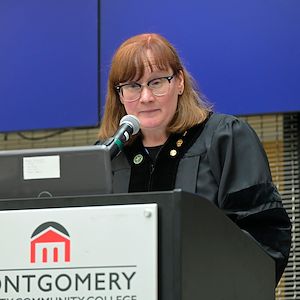 MCCC has two PTK chapters – Alpha Kappa Zeta at the Blue Bell Campus and Beta Tau
Lambda at the Pottstown Campus. Both chapters have attained five-star status, the
highest rank a chapter can earn. Dr. Catherine Parzynski, History Assistant Professor, and Dr. Cathy Hoult Shewring, History Professor, are
the advisers for Alpha Kappa Zeta, and Douglas Powell, History Assistant Professor,
and Meredith Frank, Communications Studies Assistant Professor, are the advisers for Beta Tau Lambda.
MCCC has two PTK chapters – Alpha Kappa Zeta at the Blue Bell Campus and Beta Tau
Lambda at the Pottstown Campus. Both chapters have attained five-star status, the
highest rank a chapter can earn. Dr. Catherine Parzynski, History Assistant Professor, and Dr. Cathy Hoult Shewring, History Professor, are
the advisers for Alpha Kappa Zeta, and Douglas Powell, History Assistant Professor,
and Meredith Frank, Communications Studies Assistant Professor, are the advisers for Beta Tau Lambda.
“We’re very fortunate to be named a 2025 REACH chapter,” said Parzynski, who has advised the chapter since 2007. “This award is a reflection of our student and institutional commitment to PTK.”
“A key to our success,” said Hoult Shewring, who has advised the chapter since 2016, “is we’ve had a sustained presence on campus.”
The chapter regularly hosts events and activities on campus, particularly in Parkhouse Hall, to engage students and promote PTK’s tenets of scholarship, leadership, fellowship and service, they said.
“Parkhouse is the single biggest classroom building on campus,” said Parzynski. “It gives us the best chance to meet face to face with students and talk about the benefits of PTK.”
She thanked the Student Government Association; Tyler Steffy, Director of Student Life; and James Bedrosian, Administrative Coordinator for Academic & Student Affairs, for their support in identifying potential students for PTK and putting them in touch with the organization.
Currently Alpha Kappa Zeta is engaged in a service project with Integrate for Good, a 501(c)3 nonprofit organization, which empowers students and adults of all abilities to share their talent through inclusive volunteerism, community leadership, and equitable employment. PTK members are making ‘plarn,’ or plastic yarn, from plastic shopping bags, that will be woven together into soft mats for people who are homeless to sleep on.
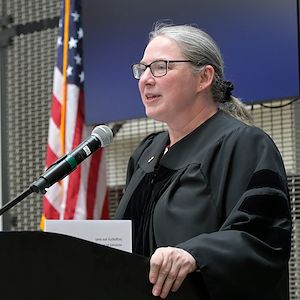 “One semester we try to connect to a service project about our population on campus,”
said Hoult Shewring. “And then another semester we will connect to a larger sense
of community. This connects to a larger sense of community. It’s important for students
to see the impact of their work on others.”
“One semester we try to connect to a service project about our population on campus,”
said Hoult Shewring. “And then another semester we will connect to a larger sense
of community. This connects to a larger sense of community. It’s important for students
to see the impact of their work on others.”
“It’s about getting them to grow as people. We try to equip them to be not just the best scholars,” she continued. “They need a 3.5 GPA to qualify for PTK, they’ve already worked on scholarship. This is about building interpersonal and leadership skills. It’s about building and supporting community.”
The REACH designation, she said, speaks to the good work PTK is doing to connect with students and set them up for success in the future. The percentage of students who participated in PTK and either graduate with an associate’s degree or transfer to a four-year institution is 91 percent. In addition, there are more than $1.5 million in competitive scholarships available to PTK students.
Phi Theta Kappa was founded in 1918 and officially recognized in 1929 by the Association of American Community Colleges. Today, it has grown from the original eight chapters to more than 1,300 and it encompasses more than 3.5 million members worldwide. PTK membership enables students to enter into an intellectual fellowship that extends beyond MCCC to regional, national and international networks.
There are numerous benefits to being inducted as a member of the Phi Theta Kappa honor society, including special recognition during the induction ceremony and at commencement, scholarships, career training opportunities, transfer success, leadership development, and member discounts.