
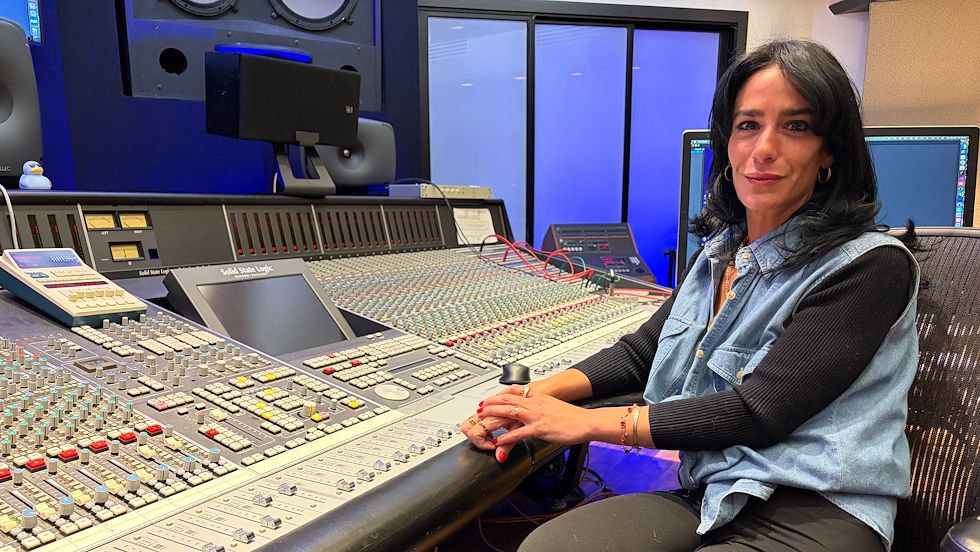
Mia Fanelli, a Sound Recording and Music Technology major in the Mix Room on the Blue Bell Campus of Montgomery County Community College. Fanelli has developed a new digital audio engineering tool called OHLA to assist individuals with sensory or perceptual differences. Photo by Eric Devlin
At Montgomery County Community College, Sound Recording and Music Technology (A.A.S.) (SRT) major Mia Fanelli has transformed her unique sensory experience into an innovative new piece of technology that will change the digital audio recording business.
Fanelli says she hears music a bit differently than the average person. Due to a neurological phenomenon known as chromesthesia (a form of synesthesia), when Fanelli hears a sound, she also experiences a lot more.
“I'll see colors, shapes, images,” she said, “or even sometimes feel or taste things.”
It’s estimated that only about 1 percent of the world’s population has chromesthesia. It helped inspire the 37-year-old from Paoli to invent an innovative piece of technology that will make digital audio tools much more usable for individuals with sensory or perceptual differences.
Creating OHLA
Fanelli recently developed a patent-pending accessibility technology designed for audio engineers, which she’s named OHLA (Opto Haptic Linear Attenuator). When working on a sound mixing board, the tool allows users to see and feel audio levels with their hands.
“You’re able to just move your fingers and have all the information right there if you don't necessarily have the ability to see,” she said. “Or if you can see but you don't have the ability to hear, you can still use this tool in a way that will give you the information that everyone else is getting. I really wanted to create a tool that meets people where they are.”
The inspiration for the tool, she said, came while working in the Mix Room on the Blue Bell Campus with David Ivory, Director of Sound Recording and Music Technology.
“We were discussing how audio recording tools haven’t evolved over time. All the tools that we use in the studio have never really changed,” she said. “The way we raise the volume or pan audio has always just been the same as it's been for the last century.”
Audio engineers look in different directions when controlling multiple control surfaces in a studio. Their hands stay on the faders while their eyes are fixed on a computer screen. Then they switch their hands to a mouse and move their head over to the faders, she said.
“So, I sat there and said there has to be a way where I can get visual and physical feedback in the fader itself and get all that information I need,” said Fanelli. “Because for me, because of my chromesthesia, I see almost whole movies play in front of me when I hear music. It’s distracting. And to look around left and right, I needed a center of focus. When I was kind of conceptualizing this, I soon realized nobody had ever done it before.”
 Fanelli has already created a working prototype of OHLA and conducted functional demonstrations
that have gained her support from influential members of the professional audio industry.
She conceptualized, coded and prototyped OHLA during the 2025 winter break. In six
weeks, from Dec. 24 to Feb. 4, she created the prototype, filed two patents — one
for OHLA hardware, one for its algorithm, and formed a Limited Liability Company (LLC).
Fanelli has already created a working prototype of OHLA and conducted functional demonstrations
that have gained her support from influential members of the professional audio industry.
She conceptualized, coded and prototyped OHLA during the 2025 winter break. In six
weeks, from Dec. 24 to Feb. 4, she created the prototype, filed two patents — one
for OHLA hardware, one for its algorithm, and formed a Limited Liability Company (LLC).
“I approached David Ivory after I had completed everything and made sure everything worked,” she said. “He encouraged me greatly from the moment I told him and has assisted in many aspects.”
Since then, her phone has been ringing off the hook with potential investors.
Standing out from the crowd
 Fanelli didn’t start at the College looking to turn heads this way. At 35, she quit
her sales position at a local winery and enrolled as a Computer Science major to try to explore her passions. She took three classes before changing her
major to SRT. MCCC gave her the space to explore her passion and find an academic
program that worked for her.
Fanelli didn’t start at the College looking to turn heads this way. At 35, she quit
her sales position at a local winery and enrolled as a Computer Science major to try to explore her passions. She took three classes before changing her
major to SRT. MCCC gave her the space to explore her passion and find an academic
program that worked for her.
“Programming was not as fulfilling for me,” she said. “I wanted to see what I was doing more, in a way, and feel it.”
When she began the program, she remembered the majority of her classmates being more than 10 years younger than her when she first started. She said she felt like they were more talented musicians, despite the fact Fanelli has taught herself to play the harp, piano and ukulele and wants to learn to play the theremin.
“All these students around me, my peers, are really, really talented,” she said, “They kind of know what they're doing. They’ve been making music for a while. They've been producing and I was just there to learn. I just want to learn everything.”
Fanelli credits the support she found at MCCC as a key part of her success.
“(Music Assistant Professor) Michael Kelly was the very first professor I met with who just kind of encouraged me in a way that I hadn't experienced,” she said. “He, David Ivory and (Sound Recording & Music Technology Assistant Professor) Howard Gordon are my main influences here and they are such a support system.” She’s currently taking Music Production with Ivory and Sound Recording Workshop II with Gordon.
Fanelli quickly learned from her classmates and fell in love with the SRT program because the level of expertise involved in creating music allowed her to explore her passion for it more deeply.
She earned placement on the Dean’s List five semesters in a row. She also is the recipient of the prestigious WSDG (Walters-Storyk Design Group) Excellence Scholarship. The scholarship is awarded to deserving students in need who have demonstrated academic excellence in MCCC’s SRT program. In spring 2026, Fanelli will graduate from MCCC and begin studying at Berkeley College of Music.
Kelly said Fanelli is a powerful example for students who are still learning to believe in themselves, at any age or background.
“Mia’s achievements reflect the highest standards of scholarship, creativity, and perseverance,” said Kelly. “Watching her grow into someone who believes in her own work and its impact has been one of the most rewarding experiences of my career. She represents the very best of our Sound Recording and Music Technology program.”
While Fanelli may have felt like she was starting from the very bottom of her class when she enrolled, she has certainly risen through the ranks and is now one of its standout stars.