

Matthew Kilbride, Montgomery County Community College Academic Technologies Innovation Specialist oversees Nursing students Jonathan April, Silvia Gonzalez and Eric Nazario as they wear virtual reality headsets to evaluate a simulated patient suffering from a heart attack. Photo by Eric Devlin
In the gymnasium inside Montgomery County Community College’s Health Sciences Center on the Blue Bell Campus, second-year Nursing students Jonathan April, Silvia Gonzalez and Eric Nazario wore virtual reality headsets as they responded to an emergency simulation of an animated male patient suffering from a heart attack in a hospital room.
“On a scale of 1-10, how bad is the pain?” April asked the patient.
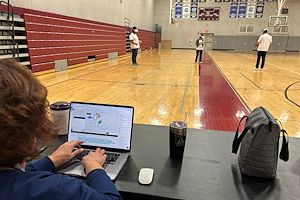 About 20 feet away, seated at a folding table on her laptop, Dr. Christine Dunigan,
Nursing Associate Professor, monitored her students’ attempts to save their patient’s
life. As students evaluated and began treatment, she clicked prompts on her screen
to redirect them, respond as the patient and deliver doctors’ orders in real time.
About 20 feet away, seated at a folding table on her laptop, Dr. Christine Dunigan,
Nursing Associate Professor, monitored her students’ attempts to save their patient’s
life. As students evaluated and began treatment, she clicked prompts on her screen
to redirect them, respond as the patient and deliver doctors’ orders in real time.
“It’s a nine,” students could hear the patient say in their headsets, after Dunigan clicked the response.
On the adjacent corner of the room, Dr. Kristin Davies, Nursing Senior Lecturer, and Dr. Elizabeth Mencel, Nursing Associate Professor, monitored other student teams responding to similar simulated emergencies of their own.
Afterward, the class gathered to debrief, discussing any challenges and how to improve in the future.
This is the second time during the fall 2025 semester that Nursing students have used the wearable, state-of-the-art technology. Previously, it was employed to respond to a simulated patient with respiratory failure from COVID-19.
The experience students gain from these virtual exercises is invaluable, said Dunigan.
“I would really love it in the future if we could do all virtual simulations,” she said. “I think it offers so much more for the students.”
“VR is a good tool,” said Mencel. “It can teach them critical thinking and clinical judgement. They need to think about what they’re going to do next.”
The pilot program is funded by a federal grant from the Carl D. Perkins Career and Technical Education Improvement Act of 2006. The Nursing department introduced the technology, which uses the pilot UbiSim software with a 50-seat license, into their classes beginning in the spring 2025 semester, said Matthew Kilbride, Academic Technologies Innovation Specialist.
The goal is to get to a point where students can facilitate a simulation themselves to practice without an instructor present to help them through it. Plans are in place to offer the pilot again in the spring, said Dunigan.
“VR is a good tool. It can teach them critical thinking and clinical judgement. They need to think about what they’re going to do next.”- Dr. Elizabeth Mencel, Nursing Associate Professor
Students enjoy using VR technology because it provides the hands-on experience they want and reinforces the lessons they’re learning in the classroom in a controlled setting, they said.
“I thought it was cool and very engaging,” said April of the simulation. “I think it was nice we got to work together in the same room.”
“I really enjoyed it,” said Gonzalez.
Before the introduction of VR technology, students sharpened their skills on a manikin in the Health Sciences Center’s second floor nursing simulation labs. With VR technology, students now have additional opportunities to practice treating patients.
“In the VR, you can get the person to talk to you. You can answer,” said Gonzalez. “You can see them breathe. They can turn blue; they breathe differently.”
“It’s next level interactive; it actually is like a proper simulation,” said Nazario. “It actually feels like we’re in a patient’s room. We have all the necessities that we need to provide adequate care.”
The VR program can be customized with each simulation to provide students with a different experience each time, said Dunigan.
“We can add family members,” she said. “You can make it as complicated as you want or as simple as you want.”
The incorporation of VR technology continues to grow at the College as different departments find creative ways to use it. Most recently, the League for Innovation in the Community College, an international nonprofit organization, presented a 2024-2025 Innovation of the Year Award to MCCC in recognition of its Virtual Reality for Public Speaking Skills project. In those classes, public speaking students used the wearable technology to practice their speeches.
Prior to that, students in the Radiography program used VR to practice taking an X-ray on a patient. Faculty members who have incorporated the technology into their classes have said it allows students to fully immerse themselves in the virtual space and it helps bring the material they are learning in the classroom to life.
“It’s a great extra resource for students to learn,” said Dunigan, “and practice on their own.”