
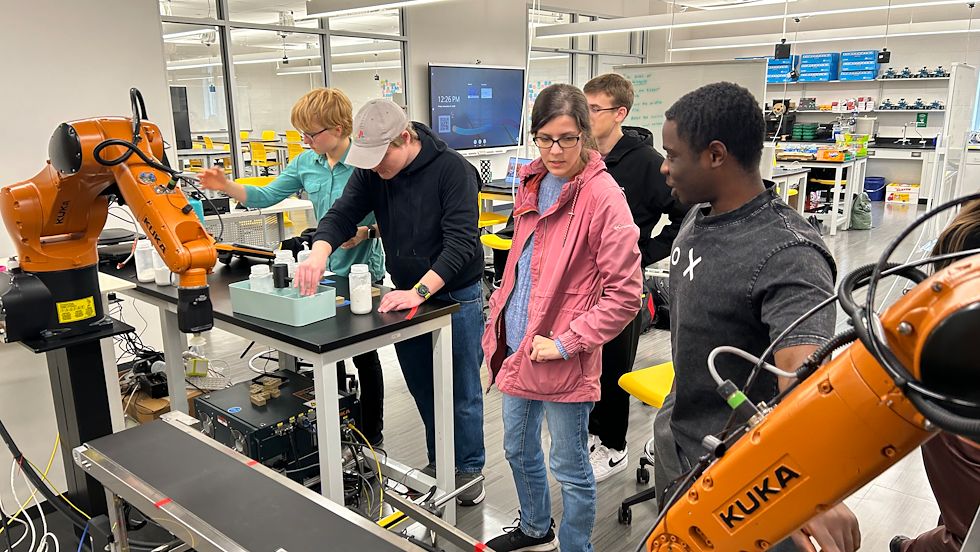
(From left) Montgomery County Community College Electrical Engineering major Rachel Myhre, Computer Science alumnus David Siegfried, ’25, Mechanical Engineering major Sarah T. Ahner and Electrical Engineering major David Olabanji work together to try to solve the Automation and Innovation Challenge by Merck & Co. Photo by Eric Devlin
A team of 10 Montgomery County Community College Engineering and Computer Science students tested their skills in Science, Technology, Engineering and Mathematics (STEM) to complete the third annual Automation and Innovation Challenge, presented by Merck & Co.
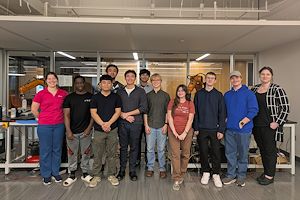 Students Sarah T. Ahner, Kyle Alcantara, Aditi Chowdheury, Miguel Grimaldos-Garcia,
Joshua Jang, Rachel Myhre, David Olabanji, Stefania Schianodicola, Van-Allen Schmidt
and Nickolay Zuyev used their combined knowledge and skills in robotics and computer
programming throughout the event, which ran Nov. 21 and 22 in the Engineering Lab
of the Science Center on the College’s Blue Bell Campus.
Students Sarah T. Ahner, Kyle Alcantara, Aditi Chowdheury, Miguel Grimaldos-Garcia,
Joshua Jang, Rachel Myhre, David Olabanji, Stefania Schianodicola, Van-Allen Schmidt
and Nickolay Zuyev used their combined knowledge and skills in robotics and computer
programming throughout the event, which ran Nov. 21 and 22 in the Engineering Lab
of the Science Center on the College’s Blue Bell Campus.
“We gather students from the Mechanical Engineering, Electrical Engineering and Computer Science programs,” said Chengyang Wang, Ph.D., MCCC Associate Professor of Engineering, “to solve an automation challenge that mimics a real-life scenario that can happen in pharmaceutical companies.”
Students were tasked with creating a proof-of-concept automation system at a fictional chemical manufacturing plant using two Kuka six-axis industrial robots and a variety of other equipment. Students had to sort bottles of chemicals into batches, based on a manifest they were provided, using one Kuka robotic arm. They then had to transfer the bottles to an associated caddy for that particular batch and transport them to a conveyor belt that leads to the second Kuka robotic arm to process the individual bottles.
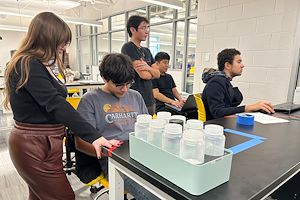 Meanwhile students needed to program the computer control system to scan each bottle
and manage the data taken from a robotic arm and compare it to the information provided
in their manifest to see if it accurately matched. Students then had to perform a
data analysis.
Meanwhile students needed to program the computer control system to scan each bottle
and manage the data taken from a robotic arm and compare it to the information provided
in their manifest to see if it accurately matched. Students then had to perform a
data analysis.
Lastly, the team gave a formal presentation to a group of Merck and MCCC employees, where they discussed challenges they overcame and how they leaned on one another’s strengths to complete the assignment.
“This is about encouraging interdisciplinary research,” said Wang, who said students come from different academic backgrounds in STEM to learn from one another. “They exchanged knowledge during the solution of the challenge.”
Wang, Merck employees Aarav Patel, Lab Automation Co-op, Carolyn Schafer, Senior Automation Specialist, and Erin Coppola, Automation Engineer, and MCCC Computer Science alumnus David Siegfried, ’25, who participated in the 2023 and 2024 Merck challenges, were on hand to lend their assistance and guidance to students throughout the event.
Students appreciated the Merck Challenge because it gave them opportunity to work with classmates from different STEM disciplines and learn new skills, they said.
“It’s been great,” said Computer Science major Joshua Jang. “My favorite part is I just like to see how everyone thinks — how Engineering students think, how Computer Science students think and how we can work together and make this project successful.”
“It’s definitely very interesting,” said Mechanical Engineering major Sarah T. Ahner. “I was worried at the beginning because I was told it’s very programming heavy. But there’s still a lot of problem solving at its core. I don’t know how to code the solutions, but I can help troubleshoot the solutions.”
“It’s been great,” said Electrical Engineering major Rachel Myhre. “Gaining hands-on experience with industrial robotics was invaluable. This challenge is a perfect example of collaborative problem-solving, requiring us to merge different perspectives to get the entire system functioning as one.”
The Automation and Innovation Challenge was initially created by retired Merck employee Scott Ziegler to establish a pipeline for MCCC students to enter the workforce.
“This is an industry-relevant challenge for students to get hands-on experience and work together in a collaborative way,” said Coppola. “It has many different ways that can be tackled but what’s really great to see is how they’re using cutting-edge technology and the skills they’ve learned in the classroom to apply to this industry challenge.”
“Once you learn the skills to work with your mind, your hands and the robots, you can take the skills anywhere you need,” said Siegfried. “It really opens a lot of pathways for students here.”
Wang stressed how grateful the College was to continue this event with Merck for the third year in a row.
“It’s been going really well,” he said. “I appreciate that they have engineers who take their time off from work to come down here and talk to students. That shows students how the knowledge they study in the classroom can actually be converted to solve real life challenges.”
“This is definitely a positive for Merck too because it allows us to build a connection in the community and at Montco and recruit real talent for the future,” said Coppola. “Hopefully, this project inspires students to start a career at Merck someday.”